
Introduction
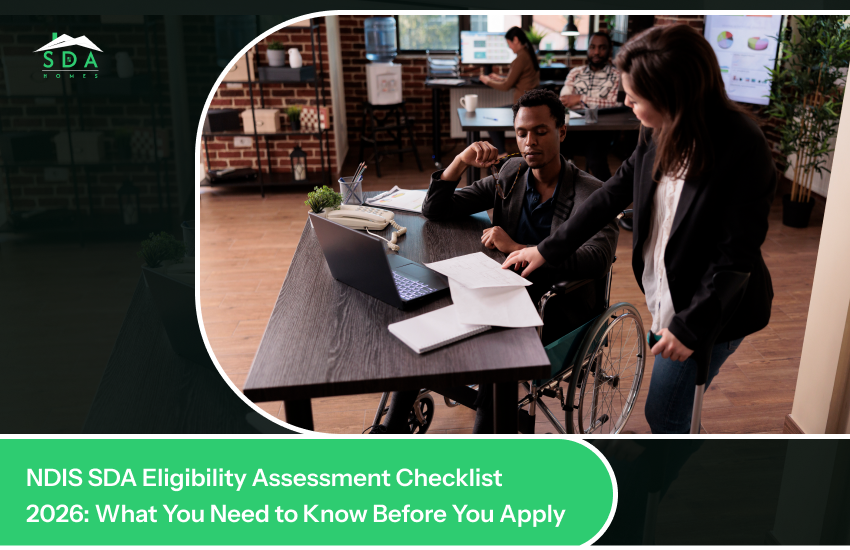
If you or someone you care for is exploring housing under the National Disability Insurance Scheme (NDIS), Specialist Disability Accommodation (SDA) is your go-to option at first. But, the first crucial question while picking teh right SDA is whether you qualify for it or not. And to know your eligibility, you must review and understand the NDIS SDA eligibility assessment checklist.
In this guide, we walk you through everything you need to know before you apply for SDA homes under the NDIS, from eligibility requirements to documents, assessment steps, and practical tips for 2026.
What is SDA, and Why does the Eligibility Matter
SDA is specially designed or purpose-built housing under NDIS for people with extreme functional impairment or very high support needs. It’s not about support services (like personal care or therapy), but about the home itself, homes built or modified to ensure safety, accessibility, independence, and dignity.
Because SDA involves specialist dwellings (with features like wheelchair accessibility, ceiling hoists, reinforced walls, automated controls, etc.), NDIS doesn’t provide it to everyone, only those whose needs go beyond what standard housing or simple modifications can address.
That’s why a formal eligibility assessment is required. Without meeting all criteria, applications may be denied, which can be disappointing and costly.
Who is eligible? Core NDIS and SDA Requirements
To qualify for SDA under NDIS, you must meet two sets of criteria: first, the basic NDIS participant eligibility. Second, the SDA-specific needs requirements.
NDIS Participant Requirements
- Be an active NDIS participant (i.e., already registered under NDIS).
- Hold Australian citizenship and a permanent residency, or a Protected Special Category Visa, and are willing to live in Australia.
- Have a permanent disability (or impairment) that causes long-term support needs.
- Be within the appropriate age range as defined by NDIS at the time of application.
SDA-specific Needs Requirements
Beyond being an NDIS participant, to access SDA funding, your needs must meet one of two main criteria:
- Extreme Functional Impairment: Your disability severely impacts your mobility, self-care, or self-management (or a combination of these).
- Very High Support Needs: You require substantial, possibly 24/7 person-to-person assistance most of the day; your informal support network (family/friends) cannot meet the level of care required; or there are safety risks if living in standard housing.
Even if you meet one of these, your case must also satisfy the SDA needs requirement. It means SDA housing must be the most appropriate way to meet your support needs compared to standard housing or other supports.
Step-by-Step NDIS SDA Eligibility Assessment Checklist 2026
Here’s a practical, up-to-date checklist (2026) to help you assess whether you may be eligible, and to prepare your application when you decide to apply through SDA Homes.
1. Confirm NDIS participation
Do you already have an active NDIS plan? If not, initiate NDIS registration first.
2. Confirm residency & citizenship
Are you, or is the applicant, an Australian citizen, permanent resident, or protected visa holder living in Australia?
3. Confirm disability status
Is there a permanent impairment causing long-term support needs (mobility, self-care, self-management, cognitive, or psychosocial)?
4. Confirm support needs level
Does the impairment translate into very high functional or very high support needs (frequent/daily assistance, risk factors, unsuitability of standard housing)?
5. Consider whether SDA is the right support option
Would accessible housing or housing modifications be sufficient, or is SDA the only suitable, necessary housing solution given your needs?
6. Gather evidence/documentation
Up-to-date NDIS plan
- Medical reports/specialist assessments
- Functional Capacity Assessment (by qualified OT / allied health professional)
- Any reports/details showing why standard housing or support services aren’t enough
7. Identify required design category
Based on your needs, identify which SDA design category you may need. Be it:
- Improved Liveability
- Fully Accessible
- Robust
- High Physical Support
This is to ensure it matches your support requirements.
8. Consider long-term benefit & value
Think about whether SDA housing will:
- Improve safety
- Maintain or improve functional capacity
- Reduce long-term support costs
- Support independence and quality of life.
Completing the above steps and confirming each step will give you strong confidence that SDA Homes (or any SDA provider) and the NDIA are likely to approve your application.
What Happens After You Submit Your Application
Once you submit your application with all required documentation, the assessment process (under 2026 rules) generally involves:
- Review by an NDIS Assessor/Planner: These people will check eligibility, support needs, and suitability.
- Determination of SDA Design Category: Based on your functional needs, to see whether you need Improved Liveability, Fully Accessible, Robust, or High Physical SDA Accommodation.
- Approval (or not): If approved, your NDIS plan will reflect SDA funding eligibility. If not approved, a review or appeal may be possible, or alternative support/housing options may be discussed.
Once approved, you’ll begin working with your SDA Service Provider to find a suitable dwelling matching your needs and approved SDA design category.
Why this Checklist Matters and How SDA Homes Helps
- Avoid delays or refusal: Missing documentation, unclear functional assessments, or poorly matched support needs are common reasons for application delays or denials. A checklist helps prevent that.
- Strengthens your application: Having functional capacity assessments, medical reports, and clear evidence helps demonstrate that SDA is “reasonable and necessary.”
- Saves time & stress: Knowing what’s needed from the start reduces back-and-forth with NDIA or providers, making your SDA approval process smoother.
- Maximises outcome: Helps ensure you are assigned to the right design category (so the home suits your needs), and that your housing option offers long-term value.
At SDA Homes, we guide you every step of the way, from understanding the checklist to gathering evidence. We also help you find the right accommodation when you submit an application and get approved.
Final Thoughts & Next Steps
The journey to securing SDA, from understanding your needs to finalising your home, can feel overwhelming. But with a clear, step-by-step NDIS SDA Eligibility Assessment Checklist 2026, you can approach this journey with confidence.
If you’re unsure whether you meet all the requirements, or if you’d like help gathering documentation and applying, SDA Homes is here for you. We believe everyone deserves a safe, accessible home, and we’ll guide you every step of the way.
Ready to take the first step? Get in touch with us today, and let’s see if SDA could be the right solution for you or your loved one.
FAQs
1. Do I need to know my SDA design category before I apply?
Not at all. You don’t have to walk into the process already knowing whether you need High Physical Support, Robust, or Fully Accessible housing.
2. Can I apply for SDA even if I’m already living somewhere safe?
Yes, you can. The question isn’t whether you’re currently safe. It’s whether your current home genuinely supports your long-term independence, mobility, comfort, and support needs.
3. Is SDA the same as SIL?
No, and it’s a common mix-up. SDA is the home (the building, design features, accessibility). SIL is the support team that helps you with daily tasks. Some people need one, some need both; it just depends on your needs.
4. How long does SDA approval usually take?
It varies, but the clearer your evidence and reports are, the faster the process tends to move. We help you get that clarity from the start.
5. What happens if my SDA application is not approved?
You still have options. Sometimes the issue is simply missing evidence or unclear documentation. You can request a review or explore other housing pathways supported by NDIS.

 By
By
 By
By