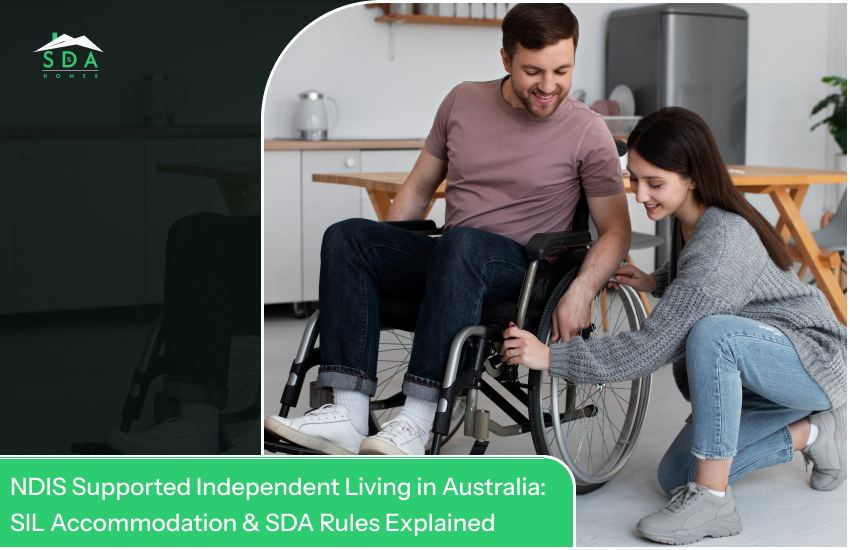

For Australians living with significant disability, stable housing and structured daily support are foundational to safety, dignity, and long-term independence. NDIS Supported Independent living is one of the key mechanisms within the National Disability Insurance Scheme (NDIS) that enables participants to access structured support in shared or individual homes. However, confusion often arises around how this model interacts with Specialist Disability Accommodation (SDA) and national housing compliance rules.
So how does NDIS Supported Independent Living help participants access SIL housing while complying with SDA rules in Australia?
In practical terms, SIL funding pays for the support workers who assist with daily living tasks, while SDA funding where eligible covers the cost of specially designed housing. The two funding streams operate separately but can work together when a participant has both high support needs and extreme functional impairment. This structured separation ensures transparency, sustainability, and compliance across all Australian states and territories.
This guide explains how the system works, what SIL includes, how SDA differs, who qualifies, and how families can navigate the process confidently.
Unserstanding NDIS Supported Independent living Within the National Disability System
The National Disability Insurance Scheme (NDIS) is a federally legislated framework administered by the National Disability Insurance Agency (NDIA). It provides individualised funding to Australians with permanent and significant disability, ensuring support is reasonable, necessary, and directly related to functional impairment.
Within this system, housing and support are intentionally separated. The NDIA does not automatically fund accommodation. Instead, it funds support required because of disability. NDIS Supported Independent living sits within Core Supports and is specifically designed to assist participants who require help with daily activities in a shared or individual living arrangement.
This distinction is important because it prevents overlap between housing costs and disability-related supports, ensuring funding remains targeted and compliant.
What Is the NDIS and How Funding Is Structured
The NDIS operates under three primary budget categories: Core Supports, Capacity Building, and Capital Supports. Core Supports include daily assistance, personal care, and community participation. Capacity Building focuses on skill development and therapy. Capital Supports cover assistive technology and, in limited cases, specialised housing.
Housing itself is generally considered a mainstream responsibility unless the participant qualifies for SDA under strict criteria. Therefore, understanding how supports and housing interact is essential for accurate planning.
Defining NDIS Supported Independent living
NDIS Supported Independent living refers to funded support provided in a participant’s home when they require significant daily assistance. It is most commonly delivered in shared housing arrangements but may also be provided in individual settings depending on needs and funding approval.
Support may include personal care, supervision, medication assistance, help with cooking, and overnight support. The funding does not pay rent or property ownership costs. Instead, it ensures the participant can live safely while building daily living capacity over time.
SIL and Specialist Disability Accommodation – Understanding the Difference
One of the most common misunderstandings is assuming SIL and SDA are the same. They are fundamentally different components of the NDIS framework.
SIL funds support services. SDA funds the physical dwelling for eligible participants with extreme functional impairment or very high support needs.
What SIL Covers in Practical Terms
SIL funding is designed to support daily functioning. Participants who cannot safely live alone due to cognitive, physical, or behavioural support needs may qualify. The funding covers the cost of support workers according to a roster of care approved by the NDIA.
For example, a participant requiring assistance with bathing, meal preparation, and overnight supervision may have 24-hour support funded under SIL. The house itself, however, could be privately rented or owned by a housing provider.
What Specialist Disability Accommodation Means
Specialist Disability Accommodation refers to purpose-built housing designed for participants with extreme functional impairment. These dwellings comply with strict national design standards and are funded under the Capital Supports budget.
SDA does not fund support workers. It funds the building component of specialised housing. Participants living in SDA may still require SIL funding if they need daily assistance.
SIL vs SDA – Clear Comparison
| Aspect | SIL | SDA |
| Primary purpose | Funds daily support workers | Funds specialised housing infrastructure |
| Funding category | Core Supports | Capital Supports |
| Pays rent | No | Contributes to dwelling cost component |
| Eligibility level | High daily support needs | Extreme functional impairment or very high support needs |
| Can exist independently | Yes | Yes |
This comparison highlights the separation between support and infrastructure. A participant may receive SIL without SDA, SDA without SIL, or both, depending on assessed needs.
How SIL Funding Is Assessed and Approved
The approval process for SIL funding requires strong functional evidence. The NDIA assesses whether the requested supports are reasonable and necessary under the NDIS Act.
Evidence and Functional Assessments
Participants must demonstrate that they require substantial daily assistance. Reports from occupational therapists, psychologists, or other allied health professionals are critical. These reports outline risks, supervision needs, behavioural concerns, and limitations in daily functioning.
The NDIA also evaluates whether informal supports, such as family care, are sustainable. SIL is approved when independent living without structured support would create significant risk.
What Supports Are Included in SIL
SIL may include assistance with personal hygiene, meal preparation, domestic tasks, medication management, behavioural support implementation, and overnight supervision. It may also include support for appointments and community engagement where linked to daily functioning.
When NDIS Supported Independent living Is Considered Reasonable
- Support must relate directly to disability needs.
- Costs must represent value for money.
- Risks of unsupported living must be documented.
- Alternative support models must be considered first.
Understanding NDIS SDA Rules and Housing Compliance
SDA funding is governed by detailed national rules to ensure fairness and sustainability.
Eligibility Criteria Under SDA
Eligibility for SDA requires evidence of extreme functional impairment or very high support needs. The NDIA conducts a rigorous assessment to determine whether mainstream housing options would be unsuitable even with modifications.
Only a small percentage of participants qualify for SDA, making accurate documentation essential.
What SDA Funding Covers
SDA funding contributes to the cost of building and maintaining compliant housing. It ensures dwellings meet design standards such as accessibility, robustness, and safety features appropriate to the participant’s impairment.
The participant still pays a reasonable rent contribution, typically aligned with Commonwealth Rent Assistance guidelines.
Design Categories and Compliance
SDA properties fall under specific design categories, including Improved Liveability, Fully Accessible, High Physical Support, and Robust. Each category addresses different levels of physical or behavioural need and must meet national certification standards.
Housing Options and SIL accommodation Models
Most participants receiving SIL live in shared arrangements. SIL accommodation often involves two to five participants sharing a home with rostered support workers. This model balances cost efficiency with high support levels.
Some participants live independently in apartments or units while still receiving daily support. The choice depends on individual goals, funding approval, and available housing supply in their region.
Shared living arrangements typically promote social engagement and structured routines, while individual models may suit participants who require privacy or have complex behavioural considerations.
Role of Providers and Coordination With SDA Homes
Service providers delivering SIL must comply with NDIS Practice Standards. They are responsible for maintaining accurate rosters of care, ensuring staff qualifications, and safeguarding participant wellbeing.
When participants reside in SDA Homes, coordination between the housing provider and the SIL provider is essential. Clear agreements define responsibilities for maintenance, tenancy management, and daily support delivery. This separation ensures compliance with funding boundaries and protects participant rights.
The NDIS Quality and Safeguards Commission oversees provider compliance nationally, ensuring consistent standards across Australia.
Family Considerations and Transition Planning
Moving into supported living can be a significant milestone for families. Emotional adjustment often accompanies practical planning. Clear communication between providers, participants, and families reduces uncertainty.
Financial clarity is particularly important. SIL funding does not remove rental responsibilities unless SDA applies. Families must understand tenancy agreements, rent contributions, and how funding interacts with income support.
Gradual transitions, including short-term stays or respite placements, often support smoother adjustments. These phased approaches allow participants to build confidence before permanent relocation.
Long-Term Outcomes and Capacity Building
The objective of supported living is sustainable independence. NDIS Supported Independent living is structured not only to provide care but to develop daily living capacity. Over time, many participants increase their ability to manage cooking, budgeting, and personal routines.
Where participants qualify for SDA, housing stability further enhances independence. Accessible design reduces reliance on physical assistance and supports safer living environments.
How NDIS Supported Independent living Strengthens Stability
- Encourages routine and structure.
- Reduces crisis-driven accommodation moves.
- Promotes social participation.
- Supports long-term housing continuity.
When participants align their SIL and SDA pathways, they achieve better safety outcomes and greater autonomy than those in unsupported housing arrangements.
Application Process for SIL and SDA
Applying for SIL begins with a comprehensive functional assessment. Providers prepare a detailed roster of care outlining required support hours and staffing ratios. This documentation is submitted to the NDIA during a plan review.
If SDA eligibility is sought, additional evidence demonstrating extreme functional impairment must accompany the application. The NDIA evaluates whether specialised housing represents value for money compared to alternatives.
Australia-Wide Consistency and Portability
Although housing supply varies between metropolitan and regional areas, the policy framework governing SIL and SDA remains consistent nationwide. NDIA decision-making criteria apply equally across states and territories, ensuring portability of funding if participants relocate.
This national consistency protects participant rights and promotes equitable access regardless of geography.
Conclusion – Structured Support and Housing Clarity
Clear separation between support funding and housing infrastructure underpins Australia’s disability housing framework. NDIS Supported Independent living funds the daily assistance required for safe and structured living, while SDA—when approved—funds specialised dwellings for participants with the highest needs.
Understanding how these components interact helps participants and families prepare accurate documentation, select appropriate providers, and secure stable long-term housing outcomes. When properly coordinated, SIL and SDA create a compliant, sustainable pathway toward independence within Australia’s national disability support system.

 By
By
 By
By