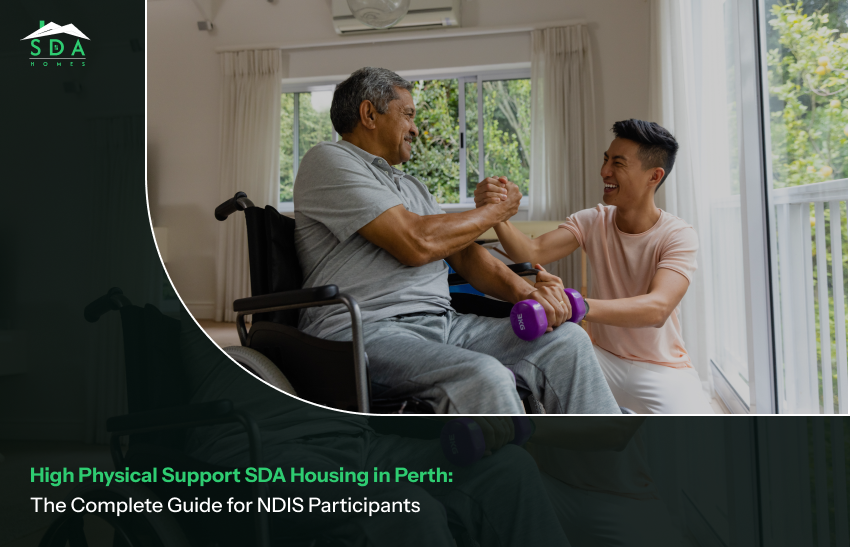

If you or someone you support has very high physical support needs, standard housing options usually fall short. High Physical Support SDA housing is purpose-built for exactly this situation: homes designed around ceiling hoists, wide corridors, reinforced fittings, and backup power for medical equipment.
NDIS jargon, design categories, and funding rules often confuse Perth families searching for this housing. This guide cuts through that. You’ll learn what High Physical Support SDA actually means, who qualifies, what the homes include, and how to secure one in Perth, Western Australia.
Quick Answer
High Physical Support (HPS) SDA housing is the most intensive of the four NDIS Specialist Disability Accommodation design categories. It’s for participants with significant physical support needs who require:
- Very high levels of assistance with daily activities
- Home modifications like ceiling hoists and wider doorways
- Assistive technology built into the home (not added later)
- 24/7 support access in most cases
Eligibility depends on your confirmed SDA funding decision from the NDIA — not just your diagnosis. In Perth, HPS homes are limited in supply, so demand consistently outpaces availability, particularly in growth corridors like Midland and the southern suburbs.
Why It Matters
Housing design directly affects independence, safety, and dignity for people with extreme functional impairment. A home without a ceiling hoist or emergency call system isn’t just inconvenient — it can stop support workers from safely caring for a participant.
Industry context: SDA is one of the fastest-growing categories of NDIS-funded housing, and High Physical Support represents the smallest but most specialised slice of that market. Because build requirements are strict and expensive (reinforced structural fittings, hoist tracking, wider door frames), supply hasn’t kept pace with demand across most Australian cities, including Perth.
Key Benefits of High Physical Support SDA Housing
- Built-in accessibility — ceiling hoists and emergency call systems are integrated at construction, not retrofitted
- Safer daily living — wide doorways and reinforced fittings reduce injury risk during transfers and mobility
- Support-ready design — layouts accommodate overnight or 24/7 support workers without compromising the participant’s privacy
- Funding certainty — SDA payments go directly to the registered provider, so tenants aren’t managing building costs themselves
- Long-term tenancy stability — unlike STA or MTA, SDA tenancies are ongoing, giving participants a permanent home rather than a temporary placement
What Qualifies a Home as “High Physical Support”
| Feature | Improved Liveability | Fully Accessible | Robust | High Physical Support |
| Typical participant need | Sensory, intellectual, cognitive impairment | Significant physical impairment | Very high support + behaviours of concern | Extreme functional impairment / very high physical needs |
| Ceiling hoists | Rarely | Sometimes | No (removed for safety) | Standard |
| Emergency call systems | No | Sometimes | Yes | Yes |
| Reinforced fittings | No | Some | Yes (impact-resistant) | Yes (structural + hoist-rated) |
| Backup power for equipment | No | No | No | Often included |
| Typical support model | Drop-in or SIL | SIL | SIL, often overnight | SIL, usually 24/7 |
Step-by-Step: How to Access High Physical Support SDA in Perth
- Get your NDIS plan reviewed — SDA isn’t automatic. Your planner or Local Area Coordinator assesses whether your functional impairment meets the threshold.
- Obtain an SDA assessment — usually completed by an Occupational Therapist who documents your physical support needs against the SDA Design Standard.
- Receive your SDA funding decision — the NDIA confirms your approved design category (in this case, High Physical Support) and building type.
- Search for matching vacancies — homes must match your confirmed category exactly; a Fully Accessible home won’t satisfy an HPS funding decision.
- Arrange SIL support (if needed) — SDA funds the building; Supported Independent Living funds the day-to-day personal care delivered inside it.
- Move in — a registered SDA provider works with your support coordinator to finalise tenancy agreements and support handover.
Best Practices When Choosing an HPS Home
- Confirm the provider is NDIS-registered — check the public NDIS Commission register before signing anything
- Match the home to your exact SDA category, not a “close enough” alternative
- Visit in person where possible — photos don’t show hoist tracking coverage or doorway widths accurately
- Ask how the home handles backup power during outages, since medical equipment often depends on it
- Confirm SIL arrangements are sorted separately from the SDA tenancy so there’s no gap in support
Common Mistakes to Avoid
- Assuming SDA and SIL are the same funding — they’re not. SDA funds the building; SIL funds the support delivered inside it.
- Signing a lease before the SDA funding decision is confirmed — this can leave participants without funding to cover the home.
- Choosing location over design match — a beautifully located home in the wrong category won’t be funded.
- Overlooking provider registration status — unregistered providers can’t claim SDA payments through the NDIA on your behalf.
- Underestimating wait times — HPS homes are in short supply in Perth, so early planning matters.
Expert Insight
Participants requiring High Physical Support almost always need SIL support running alongside their SDA tenancy from day one. Coordinating both simultaneously rather than sorting SDA first and support second consistently produces smoother, faster move-ins and avoids participants being “housed but unsupported” in the interim.
Future Trends in High Physical Support SDA
- Smart home integration — voice-activated environmental controls (lighting, doors, climate) are increasingly built into new HPS builds
- Growth corridor development — Perth’s southern and eastern suburbs (Midland, Hilbert, Gosnells) are seeing new SDA stock built to meet rising demand
- Tighter compliance auditing — the NDIS Commission continues to increase scrutiny on SDA Design Standard compliance, which should improve build quality over time
Frequently Asked Questions
What is High Physical Support SDA housing?
It’s the NDIS SDA design category built for participants with extreme functional impairment or very high physical support needs, featuring ceiling hoists, emergency call systems, and reinforced fittings.
Who is eligible for High Physical Support SDA?
Eligibility requires a confirmed SDA funding decision from the NDIA specifying the High Physical Support category, based on an OT assessment of functional impairment.
Does High Physical Support SDA include personal care support?
No. SDA funds the physical home only. Personal care and daily support are funded separately, usually through Supported Independent Living (SIL).
How is High Physical Support different from Robust SDA?
Robust homes use impact-resistant fittings to support participants with very high support needs who may also display behaviours of concern. High Physical Support homes focus on physical mobility needs, with hoists and medical equipment provisions instead.
How long does it take to move into a High Physical Support SDA home in Perth?
Timelines vary based on vacancy availability and your SIL arrangements, but confirming your SDA funding decision early is the biggest factor in reducing wait time.
Conclusion
High Physical Support SDA housing exists for one reason: to make safe, independent living possible for people with the highest physical support needs. Getting it right means matching your confirmed SDA category to a genuinely compliant home, and lining up SIL support so you have care in place from day one.
In Perth, HPS vacancies move quickly particularly in growth areas like Midland. If you’re navigating an SDA funding decision, start the vacancy search early and work directly with a registered provider who can confirm category compliance before you commit.
Key Takeaways
- High Physical Support is the most intensive of the four NDIS SDA design categories
- Homes include ceiling hoists, emergency call systems, and reinforced, hoist-rated fittings
- SDA funds the building; SIL funds the personal support delivered inside it
- Eligibility requires a confirmed SDA funding decision from the NDIA, not just a diagnosis
- Perth’s HPS supply is limited, so early planning and provider engagement matter.

 By
By
 By
By